Pasar al contenido principal
Inicio

Main navigation

  • Acerca de
  • Unirse
  • Recursos
  • Iniciativas
    • Desafío de la salud por el clima
    • Menos huella, más salud
    • Hospitales que curan el planeta
    • Carrera hacia el cero
    • Menos plástico, más salud
    • CARE
  • Agenda global
  • Noticias
  • en
  • es

Additional header menu

  • Acceder a Conectad@s

Resultados de búsqueda

Fundado 302 resultados
Página
Liderazgo
 
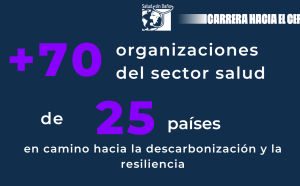
Nuevo hito en la Carrera hacia el cero: 70 organizaciones del sector salud de 25 países se comprometen con cero emisiones netas
News
Carrera hacia el cero: 70 organizaciones del sector salud de 25 países se comprometen con cero emisiones netas
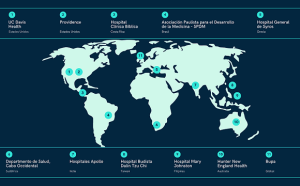
Más de 70 organizaciones del sector, que representan a más de 14 000 hospitales y centros de salud de 25 países, se han unido a la campaña.
Página
Premios Desafío de la salud por el clima
Health Care Climate Challenge (HCCC) participants are on the cutting edge of defining what truly climate-smart health care can and should be. Each year, we recognize their progress and commitments with our Climate Champion Awards. It's an opportunity to celebrate achievements across our three pillars of mitigation, resilience, and leadership and to showcase their leadership to the health care sector around the world. 
Encuentro global para la acción climática en salud
News
Organizaciones de salud de todo el mundo se unen para trazar el camino hacia la acción climática
Representantes de hospitales y sistemas de salud se reunieron para intercambiar experiencias en atención sanitaria climáticamente inteligente.
Página
Ganadores del Desafío de la salud por el clima
Since 2015, Health Care Without Harm has been honouring institutions who excel in Leadership, Resilience, and Mitigation. With almost 500 participants, the Climate Challenge celebrates exceptional achievements and contributions in these three pillars. Join us in recognizing the remarkable winners who have raised the bar and redefined climate-smart healthcare, fostering transformative change within the sector and the world.
Xylene
News
Estudio de caso | El programa de reciclaje químico de xileno del Hospital Real ofrece éxito sostenible y ahorro de costos
El Royal Hospital, el mayor centro de salud de atención terciaria de Omán, ha implementado con éxito un programa de reciclaje de productos químicos de xileno, lo que demuestra su compromiso con la sostenibilidad y la innovación en el cuidado de la salud.
V Conferencia Latinoamericana de la Red Global de Hospitales Verdes y Saludables
News
Se celebró la V Conferencia Latinoamericana de la Red Global de Hospitales Verdes y Saludables
El 12 y 13 de julio de 2023, Salud sin Daño celebró la V Conferencia Latinoamericana de la Red Global de Hospitales Verdes y Saludables, un espacio de encuentro para dialogar sobre los principales desafíos ambientales y respuestas del sector salud y conocer experiencias concretas que han generado avances en establecimientos de salud de la región, en el marco de los objetivos planteados en la Agenda Global para Hospitales Verdes y Saludables.
Página
Únase a la Red Global de Hospitales Verdes y Saludables con establecimientos de salud de todo el mundo
Página
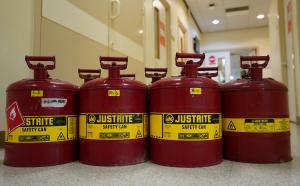
Sustancias químicas
The Issue Toxic chemical exposures begin before birth and co ntinue throughout our lives. Many of these chemicals have been linked to serious illnesses, including asthma, infertility, learning disabilities, Parkinson’s disease and cancer. The health care sector is a major consumer of chemicals including those well documented to cause serious impacts on health and the environment. Thus, a sector whose mission it is to protect human health is contributing to the burden of disease. By addressing chemical exposure in health settings, the health sector can not only protect  patient and worker health, but also actively demonstrate the safe management of chemicals thereby leading by example. Action Items Develop institution-wide chemicals and materials policy and protocols to protect patient, worker, and community health and the environment, while helping drive society wide demand for alternatives. Implement a facility -specific chemicals action plan with benchmarks and timelines. Participate in the WHO-HCWH Global Mercury-Free Health Care Initiative by substituting all mercury thermometers and blood pressure devices with safe, accurate, affordable alternatives. Address the use of chemicals of concern, including, for example, glutaraldehyde, halogenated fire retardants, PVC, DEHP and BPA, and seek safer alternatives and substitutes. Adopt policies that require disclosure of chemical ingredients in products and materials and seek to ensure that all ingredients have undergone at least basic toxicity testing. When products or materials are identified that contain Substances of Very High Concern — substances that have been identified as carcinogenic, mutagenic or toxic for reproduction, or that are persistent and bioaccumulative or warrant similar concern — hospitals should make it a high priority to replace them with safer alternatives.
Página
Residuos
The Issue Hospitals generate millions of tons of waste each year. Unfortunately, health care waste management is still poorly funded and implemented. The combined toxic and infectious properties of medical waste represent an underestimated environmental and public health threat. A recent literature review came to the conclusion that over half the world’s population is at risk from the health impacts of healthcare waste. Burning of medical waste generates a number of hazardous gases and compounds, including hydrochloric acid, dioxins and furans, and the toxic metals lead, cadmium, and mercury. The disposal of solid waste produces greenhouse gas emissions, including methane, a greenhouse gas twenty-one times more potent than carbon dioxide. Properly managed, healthcare waste should not cause any adverse impacts on human health or the environment. Medical waste management is complex and success is in large part dependent on changing the habits of hospital staff. A variety of non-burn technologies are available that can safely disinfect, neutralize or contain the wastes for landfill disposal. Information on alternative treatment technologies and waste Management is freely available. Action Items Reduce, treat and safely dispose of healthcare waste Protect public health by reducing the volume and toxicity of waste produced by the health sector, while implementing the most environmentally sound waste management and disposal options.
Página
Energía
The Issue Greater energy efficiency and transitioning to clean, renewable energy sources, such as solar and wind, can both significantly reduce greenhouse gas emissions and protect public health from the myriad impacts of climate change, including increased heat-related illnesses, the expansion of vector borne diseases, increased droughts and water scarcity in some regions and storms and flooding in others. Moving away from fossil fuels also brings with it the health and economic co-benefit of reductions in hospital admissions and treatments for chronic illnesses such as asthma, lung and heart disease caused by the pollution created from the extraction, refining and combustion of coal, oil and gas. The health sector consumes significant amounts of fossil fuel energy, although there are no adequate figures for most countries. Health-care facilities can also significantly cut greenhouse gas emissions and energy costs over time by using alternative forms of clean and renewable energy – such as solar and wind energy, and biofuels that do not undermine public health. Action Items For existing buildings, implement an energy conservation and efficiency program that will reduce energy consumption by a minimum of 10% in a single year, and will continue to produce ongoing energy savings of 2% per annum, resulting in a 10% reduction in each five year period. For new buildings, design to achieve building energy performance targets of 320 kWh/sq m or less. Conduct regular energy audits and use the results to inform awareness and retrofit programs. Once efficiency measures are implemented, investigate the purchase of clean, renewable energy, and if available, purchase at least five percent at the next available opportunity. In existing plants, shift to cleaner boiler fuels. Investigate sources of onsite, clean, renewable energy and include its generation in all new building plans. Identify potential co-benefits of climate mitigation efforts that reduce greenhouse gas emissions and local health threats, while saving money at the same time. Integrate occupant education and awareness programs to reduce energy consumption related to occupancy. In mechanically conditioned spaces, turn thermostats down a few degrees in winter or cool climates, and up in summer or warm climates. Even a slight shift can create significant energy savings.
Página
Agua
The Issue Much healthcare delivery in developing countries takes place in settings where there are inadequate or non-existent municipal water or treatment facilities. This lack of water and sanitation infrastructure is a major problem that directly impacts hospitals and health care systems – either overburdening them with more disease in the population, or because they cannot count on basic water, sewage and waste disposal services to carry out their mission, or both. When water is amply available, hospitals are often prodigious consumers in various facets of their operations. Overall, there are few reliable global water consumption benchmarks in healthcare. In general, health facilities can conserve water resources by closely metering water use, installing water-efficient fixtures and technologies, growing drought-resistant landscape, and making sure that leaks are quickly repaired. For even greater impact on overall usage, hospitals in a number of countries are harvesting rainwater. Others recycle water for process purposes Action Items Establish a framework that aspires to “net zero water use” within a hospital system. Implement water conservation strategies: install efficient faucets and toilets, routinely check plumbing and pipes to prevent leaks, eliminate seal and cooling water on medical air compression and vacuum pumps, and retrofit refrigeration systems. Switch from film-based radiological imaging equipment, which uses large quantities of water, to digital imaging, which uses no water and no polluting radiological chemicals. Landscape grounds using drought-resistant plants to minimize water use. Consider harvesting rainwater and/or recycling water for process water uses. Eliminate bottled water facility-wide if high quality potable water is available. Regularly analyze water quality. Where the health facility has access to potable water but it is not readily available in the community, develop programs to provide the community with potable water as a public health service. Implement on-site wastewater treatment technologies when no municipal service is available. Develop joint projects with the community to improve and protect water supplies; support initiatives for public systems to improve water quality, water delivery and wastewater systems for the entire population.

Paginación

  • Primera página first
  • Página anterior previous
  • …
  • …
  • Siguiente página next
  • Última página last
Inicio

La Red Global de Hospitales Verdes y Saludables es una iniciativa de Salud sin Daño

Footer menu

  • Acerca de
    • Red Global
    • Agenda Global
    • Unirse a la red
    • Sobre Salud sin Daño
  • Recursos
    • Conectad@s
    • Hipócrates
    • Documentos guía
    • Estudios de caso
    • Seminarios web
  • Iniciativas
    • Desafío de la salud por el clima
    • Menos huella, más salud
    • Hospitales que curan el planeta
    • Carrera hacia el cero
    • CARE
Copyright 2026
Términos de uso - Política de privacidad
LinkedIn Bluesky Youtube Facebook